

AI agents are gradually becoming an important backbone supporting the future of work, development, and management. These AI agents rely on a tech stack, or a layered system of advanced tools that help these agents function.
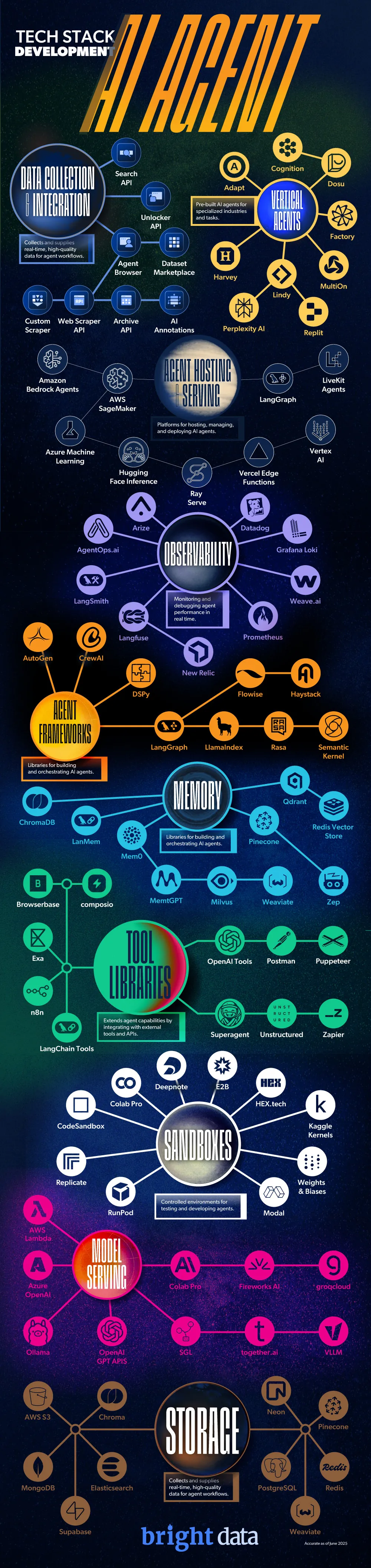
The first step in building smart AI agents is to collect and integrate real-time, high-quality data for agent workflows. Data is a critical component for any AI agent to operate optimally by understanding the world it operates in. Once an agent has accessed the data it needs, it requires a place to operate a digital environment where it can take action. This is where agent hosting services come in–they supply the infrastructure that transforms AI agents into active, autonomous systems. These platforms can handle functions such as task coordination, execution, and scaling.
The more independently AI agents operate, the more essential it is for developers to understand the actions they are taking and why. Observability tools help developers monitor and debug agent performance in real time. The growing complexity of AI agents also calls for frameworks that define how these agents are structured and interact with tools.
With memory systems, AI agents are able to build long-term understanding and recollect past interactions, making them essential for personalization and continuity. AI agents use tool libraries to interact with external systems, APIs, databases, and more while sandboxes let AI agents write and run code in safe, isolated environments.
Model serving is a very important component of AI agents that affects an agent’s effectiveness as it provides the reasoning and language generation that fuels agent decision. Storage systems help with saving outputs and maintaining states across sessions that are essential for reproducibility and continuous improvement.
There are multiple layers of AI agent tech stacks, but their capabilities rely on the data that makes up their foundation.
Source: Bright Data