


Pricing mortgages is incredibly difficult due to the sheer amount of financial modeling and mathematical calculations involved. For this reason, ensuring that a prospective borrower’s information is complete and accurate is crucial. To get a complete financial picture for borrowers, lenders have traditionally relied upon tri-merge credit reports. This is a type of report that orders information from the major 3 credit bureaus, Equifax, Experian, and TransUnion. Once this information is ordered, mortgage lenders analyze the borrower’s complete financial picture and determine eligibility. If deemed eligible, the median of the 3 credit scores is taken in order to price the mortgage.
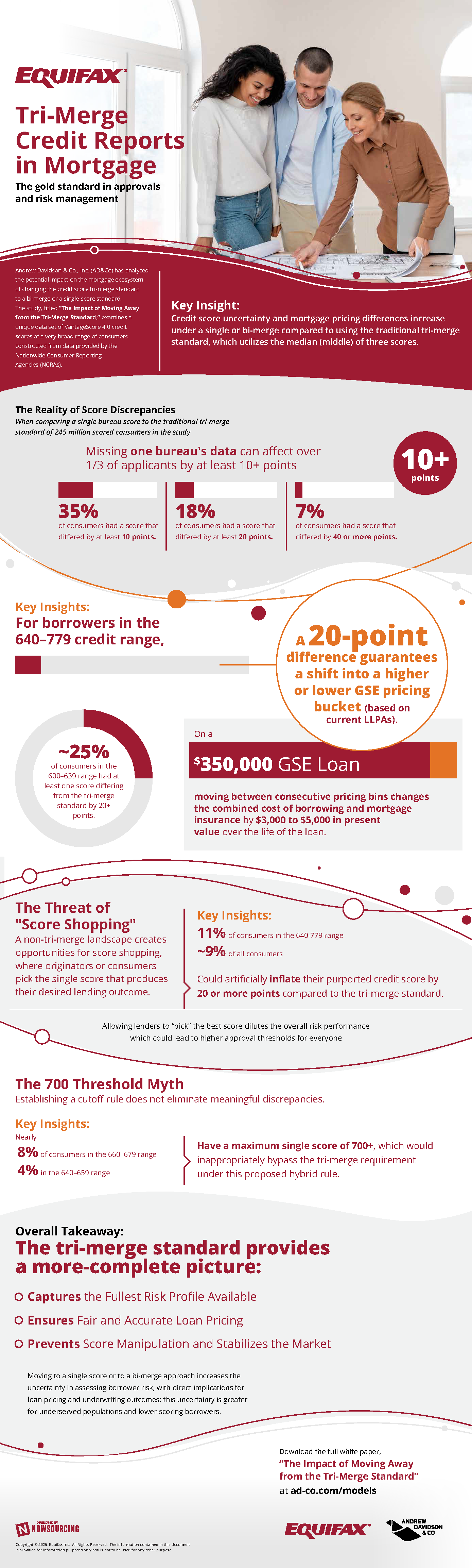
Recently, however, some mortgage lenders have started ordering bi-merge credit reports. This is a type of report that uses only 2 of the 3 credit bureaus and determines eligibility based on that information. While this may seem more convenient, there is a great deal of accuracy lost by omitting just 1 bureau. In fact, it is estimated that 35% of consumers saw a credit score variance of over 10 points when comparing bi-merge and tri-merge credit scores.
Ultimately, to make sure that the mortgage is based on accurate numbers, getting as much information as possible is still king. Ordering tri-merge credit reports is the best way to ensure that mortgages are being priced fairly for both lenders and borrowers.
Source: Equifax